|
בס"ד
Throughout my year of
learning and living in Israel
many friends and family have been asking me questions about my experiences.
The majority of the inquiries that I have fielded have been what I have
expected and therefore I basically knew what my answers would be. One
question, however, that comes up the most often has been the hardest one to
answer. Everyone wants to know what it's like to be living in Israel
during these hard times and if my year of learning has been compromised
because of the situation. At the risk of being viewed as a cold-hearted
person, I was always telling everybody that it wasn't as bad as the media
made it out to be and that life was going on as normal as possible. For me
personally that was exactly what was happening. Besides the daily Tehillim and the constant worry of my parents, Yeshiva
was pretty much going the way I had anticipated.
However, as the
newspaper was looking more like an obituary everyday, I decided I needed to
do something about it. I felt the need to contribute. I needed to answer the
question: How did you contribute to the situation in Israel?
How did you affect the Matzav (situation)?
Because of my previous
experience working for the Teaneck Volunteer Ambulance Corps. , I thought
that perhaps my small contribution to Israeli society would be to volunteer
for Magen David Adom (MDA). I did a little research and ended up applying for
a MDA program run through the Jewish Agency. I had an interview with the head
of the Foreign Affairs department of MDA, a young man by the name of Yochai
Porat. The interview went as well as I could have hoped for. All that was
left was to complete my application.
Unfortunately, Yochai
was going on Miluim (reserve duty) and I had
to wait until he returned.
Last Sunday I got word
of yet another horrible terrorist attack. This time an Israeli checkpoint
outside Ramallah was attacked by a lone sniper
killing seven soldiers including a medic and three civilians. As depressing
and sad as the news was, I, as well as all the other boys in Yeshiva went on
with our daily activities. The next morning I opened up the newspaper to find
a list of names of the soldiers killed in the attack. The very first name
listed, the medic, was Sergeant-Lieutenant Yochai Porat. Needless to say,
that hit a little too close to home since I still had his business card in my
wallet, his cellphone number stored in my phone and
I was supposed to call him in a few days.
After a few phone
calls and arrangements I found myself at the military cemetery in Kfar Saba.
I stood there by myself and watched as an additional four hundred people,
some in MDA uniforms and others in IDF uniforms, filed in to pay their last
respects to the fallen soldier and friend. Thank-G-d I've only been to a few
funerals in my lifetime, and they had all been civilian. Military funerals
are much different, especially in Israel.
The coffin, draped with an Israeli flag (representing the nation of which
Yochai as well as countless other Jewish fighters have been killed defending)
was proceeded by Yochai's unit. All boys my age in
their neatly pressed IDF uniforms with their gray berets tilted slightly to
the left. Underneath their black sunglasses I could make out the tears
rolling down their faces.
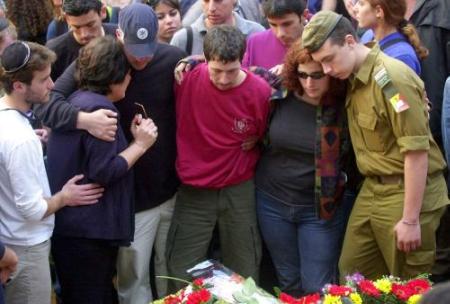
Funeral of Yochai Porat, March 4, 2002. AP
After burying Yochai
his brother, sister, mother and father all spoke. They spoke about Yochai's
life, his death, and what he meant to them all. The funeral ended with a gun
salute by his unit; the sound of the machine guns piercing the silence.
In retrospect what
struck me most about the ceremony was that when I first arrived I felt like
an outsider, after all, I met Yochai only once. However, when I left I felt
part of the nation, and therefore part of the country. As I watched the unit
of soldiers slowly marching back exactly as they had come only this time
without Yochai, I couldn't help but realize that they were going right back
to the front-lines to defend the country.
I returned to my
insulated and isolated Yeshiva and for the next few days I couldn't stop
thinking about Yochai.
From now on when I
read the casualty count in the morning paper I don't just see soldiers of a
country. I see guys my age, defenders of our country and nation, Jewish
fighters, sons, brothers and Yochais. I now have a
new perspective of the situation. A situation of which we all must feel the
affects not because we know Yochai's family rather because we are Yochai's
family. I realize now that my goals were all wrong. Instead of trying to figure
out ways that I can have an affect on the situation I need to make sure the
situation effects me. This has become a central goal
and accomplishment of mine over the year and my experience in Israel
has been shaped not despite the situation but by the situation.
Sincerely,
Judah
|


